C# Webbrowser Edge

Equal Employment Opportunity Complaints. Applicants or employees who believe they have been discriminated against on the bases of race, color, religion, Sex/gender (sexual orientation and gender identity), national origin, age, disability, genetic information (including family medical history), and/or reprisal for prior participation in the EEO process can raise their concerns through CIA’s.
Source code:Lib/webbrowser.py
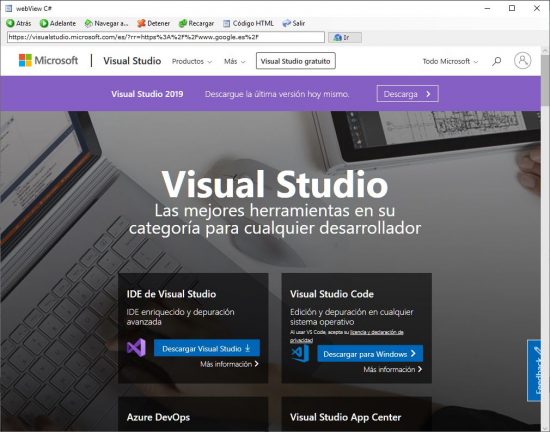
- Embed a Chromium-based browser component into your.NET application to display modern web pages built with HTML5, CSS3, JavaScript etc.
- Swanson would eventually buy the company from Jerpe and rename it C.A. Swanson and Sons, as his sons Gilbert and Clarke had joined the business. The frozen food industry began to dramatically change surrounding the time of World War II. As men were required on the battlefield, women became more needed in the workforce.
The webbrowser module provides a high-level interface to allow displayingWeb-based documents to users. Under most circumstances, simply calling theopen() function from this module will do the right thing.
Under Unix, graphical browsers are preferred under X11, but text-mode browserswill be used if graphical browsers are not available or an X11 display isn’tavailable. If text-mode browsers are used, the calling process will block untilthe user exits the browser.
If the environment variable BROWSER exists, it is interpreted as theos.pathsep-separated list of browsers to try ahead of the platformdefaults. When the value of a list part contains the string %s, then it isinterpreted as a literal browser command line to be used with the argument URLsubstituted for %s; if the part does not contain %s, it is simplyinterpreted as the name of the browser to launch. 1
For non-Unix platforms, or when a remote browser is available on Unix, thecontrolling process will not wait for the user to finish with the browser, butallow the remote browser to maintain its own windows on the display. If remotebrowsers are not available on Unix, the controlling process will launch a newbrowser and wait.
The script webbrowser can be used as a command-line interface for themodule. It accepts a URL as the argument. It accepts the following optionalparameters: -n opens the URL in a new browser window, if possible;-t opens the URL in a new browser page (“tab”). The options are,naturally, mutually exclusive. Usage example:
The following exception is defined:
webbrowser.Error
Exception raised when a browser control error occurs.
The following functions are defined:
webbrowser.open(url, new=0, autoraise=True)¶Display url using the default browser. If new is 0, the url is openedin the same browser window if possible. If new is 1, a new browser windowis opened if possible. If new is 2, a new browser page (“tab”) is openedif possible. If autoraise is True, the window is raised if possible(note that under many window managers this will occur regardless of thesetting of this variable).
Note that on some platforms, trying to open a filename using this function,may work and start the operating system’s associated program. However, thisis neither supported nor portable.
Raises an auditing eventwebbrowser.open with argument url.
webbrowser.open_new(url)¶Open url in a new window of the default browser, if possible, otherwise, openurl in the only browser window.
webbrowser.open_new_tab(url)¶Browser Control Edge
Open url in a new page (“tab”) of the default browser, if possible, otherwiseequivalent to open_new().
webbrowser.get(using=None)¶Return a controller object for the browser type using. If using isNone, return a controller for a default browser appropriate to thecaller’s environment.
webbrowser.register(name, constructor, instance=None, *, preferred=False)¶Register the browser type name. Once a browser type is registered, theget() function can return a controller for that browser type. Ifinstance is not provided, or is None, constructor will be called withoutparameters to create an instance when needed. If instance is provided,constructor will never be called, and may be None.

Setting preferred to True makes this browser a preferred result fora get() call with no argument. Otherwise, this entry point is onlyuseful if you plan to either set the BROWSER variable or callget() with a nonempty argument matching the name of a handler youdeclare.
Changed in version 3.7: preferred keyword-only parameter was added.
A number of browser types are predefined. This table gives the type names thatmay be passed to the get() function and the corresponding instantiationsfor the controller classes, all defined in this module.
Type Name | Class Name | Notes |
|---|---|---|
|
| |
|
| |
|
| |
|
| |
|
| |
|
| |
|
| (1) |
|
| (1) |
|
| (1) |
|
| |
|
| |
|
| |
|
| |
|
| |
|
| |
|
| |
|
| (2) |
|
| (3) |
|
| (3) |
|
| |
|
| |
|
| |
|
|
Notes:
“Konqueror” is the file manager for the KDE desktop environment for Unix, andonly makes sense to use if KDE is running. Some way of reliably detecting KDEwould be nice; the
KDEDIRvariable is not sufficient. Note also thatthe name “kfm” is used even when using the konqueror command with KDE2 — the implementation selects the best strategy for running Konqueror.Only on Windows platforms.
Only on Mac OS X platform.
New in version 3.3: Support for Chrome/Chromium has been added.
Here are some simple examples:
Browser Controller Objects
Browser controllers provide these methods which parallel three of themodule-level convenience functions:
C# Webbrowser For Edge
controller.open(url, new=0, autoraise=True)¶Display url using the browser handled by this controller. If new is 1, a newbrowser window is opened if possible. If new is 2, a new browser page (“tab”)is opened if possible.
controller.open_new(url)¶Open url in a new window of the browser handled by this controller, ifpossible, otherwise, open url in the only browser window. Aliasopen_new().
controller.open_new_tab(url)¶Open url in a new page (“tab”) of the browser handled by this controller, ifpossible, otherwise equivalent to open_new().
Footnotes
Executables named here without a full path will be searched in thedirectories given in the PATH environment variable.
In aviation, CRAFT is a mnemonic for the essential elements of a clearance under instrument flight rules (IFR).[1]
Overview[edit]
CRAFT stands for:
C Compiler

- Clearance limit, the end point of the clearance (usually, but not always, the destination airport)
- Route, the route that the flight is to follow as part of the clearance (often the route originally filed, although ATC may change this)
- Altitude, the initial altitude to be maintained by the flight, plus, in many cases, a time at which cruise altitude clearance may be expected
- Frequency, the frequency to which the pilot(s) should tune upon leaving the departure airport
- Transponder, the transponder code that must be set for the aircraft prior to departure and during the flight. T also stands for time, as in void time, if one is issued. A void time is an expiration time, meaning, the IFR clearance is voided if the aircraft is not airborne by the void time.[1]

Example[edit]
Consider the following example of an IFR clearance:
- N12345 cleared to Las Vegas airport via the HOLTZ seven departure, Daggett transition, then as filed, climb and maintain five thousand, expect flight level three three zero one zero minutes after departure, departure frequency is one two four point five, squawk six five six two.
In this example, the clearance limit is Las Vegas Airport. The route is the HOLTZ7 Standard Instrument Departure, with a transition fix at the Daggett (DAG) VOR, and the rest of the route is as filed in the flight plan. The flight should climb to and maintain 5000 feet initially, and further clearance to FL330 may be expected (but is not guaranteed) ten minutes after departure. The frequency to which the crew should tune after departure is 124.50 MHz, and the transponder should be set to 6562 before departure. There is no void time in this example.
Note: This example is typical in the United States; phraseology may vary in other countries, although the essential elements remain the same. For example, European controllers do not generally specify altitudes or the departure frequency as part of the clearance.
References[edit]
- ^ abRichard L.Collins, 'Is Fatigue From Turbulence Breaking Airframes?', Flying Magazine, Vol. 132, No. 8, p.61
- Transportation Department, Federal Aviation Administration, Flight Standards Service, Instrument Flying Handbook, Government Printing Office, 2008